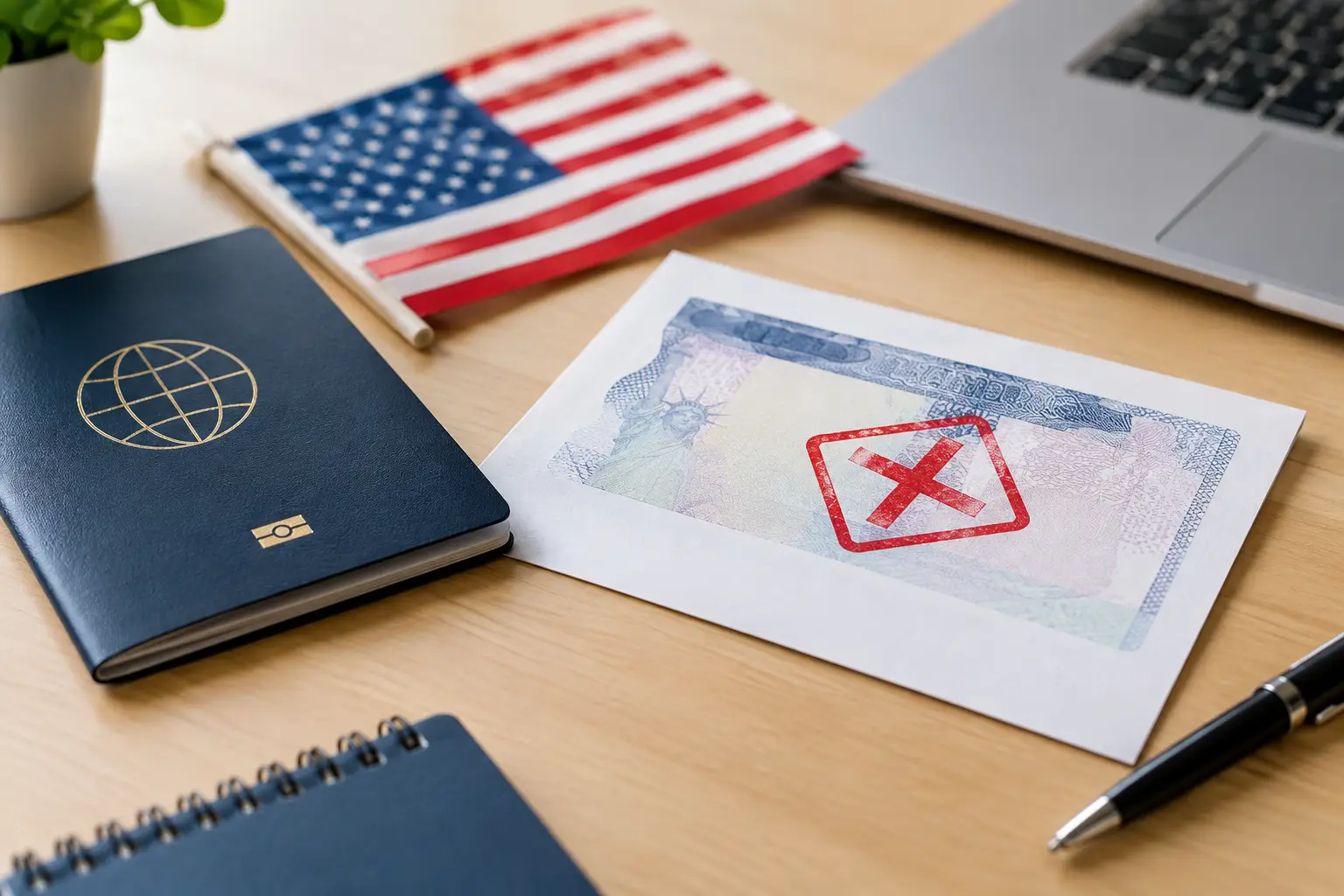
A US visa refusal can halt a planned wedding, job start date, university course or business expansion with very little warning. The difficulty is not simply that the application was unsuccessful. It is understanding what the decision legally means, whether the underlying issue can be corrected, and whether a further application could create additional risk.
A refusal is not one standard outcome. The law, the visa category, the evidence presented and the officer’s concerns all matter. Treating every refusal as a paperwork problem is a costly mistake. Some cases require stronger evidence; others require a material change in circumstances, a different immigration route, or a waiver strategy before another application is sensible.
What a US visa refusal actually means
The refusal notice should be read carefully. It will usually cite a section of US immigration law, but the practical significance is not always obvious. A verbal explanation at interview may be brief, and it is rarely a complete legal analysis of the case.
A refusal under section 214(b), for example, is fundamentally different from a refusal based on inadmissibility under section 212(a). A refusal under section 221(g) can indicate that the case is not ready for final adjudication, rather than that the applicant has permanently failed to qualify.
The first task is to identify the decision accurately. That means reviewing the application submitted, the supporting evidence available at the time, interview answers, prior US immigration history and the exact wording of the refusal notice. Without that diagnosis, a reapplication is often little more than a repeat of the same weak case.
Section 214(b): failure to establish eligibility
Section 214(b) is commonly encountered in visitor, student and other non-immigrant visa applications. In broad terms, the applicant has not persuaded the consular officer that they qualify for the visa and, where relevant, that they will leave the United States at the end of their authorised stay.
For a visitor visa, an applicant may have genuine reasons to return to the UK or another country: employment, a business, family responsibilities, property, studies or financial commitments. But genuine circumstances must still be presented credibly and consistently. A high bank balance alone does not prove non-immigrant intent. Equally, a low income does not automatically prevent approval if the trip is realistic and the wider circumstances are coherent.
For student and work visas, the focus may include the credibility of the course or role, funding, career progression, the sponsoring organisation and the applicant’s long-term plans. An answer that sounds improvised, or conflicts with the DS-160 or prior immigration record, can undermine an otherwise legitimate application.
Section 221(g): a refusal pending further action
A section 221(g) decision is often described as administrative processing or a request for further documents. It is technically a refusal at that stage, but it may be resolvable if the applicant provides what has been requested or waits for required checks to finish.
The appropriate response depends on the reason given. If the consulate has asked for a specific document, provide precisely that document in the requested format and within the stated timeframe. Do not use the opportunity to send a disorderly bundle of unrelated papers. If the case has entered administrative processing, repeated enquiries rarely accelerate security or background checks.
Where the request exposes a deeper issue – such as uncertainty about a proposed US role, source of funds, qualifications or the relationship behind a family application – legal review may be needed before responding. More documents do not necessarily mean better evidence.
Section 212(a): inadmissibility concerns
A refusal under section 212(a) can be more serious. It may relate to prior overstays, misrepresentation, criminal matters, unlawful presence, health-related grounds or other statutory bars. The consequences vary substantially. Some grounds are permanent, some expire after a defined period, and some may be waived if the legal requirements are met.
A waiver is not a request for sympathy. It is a legal application requiring the correct waiver route, careful factual analysis and evidence directed to the relevant statutory test. In some cases, eligibility depends on demonstrating extreme hardship to a qualifying US citizen or lawful permanent resident relative. In others, the waiver framework is entirely different.
Applicants should not assume that a previous overstay or inaccurate answer is minor because it occurred years ago. Nor should they accept an inadmissibility finding without checking the factual and legal basis. The correct strategy may be to challenge an error, establish that no bar applies, wait until a bar has expired, or prepare a waiver application.
Common causes of a US visa refusal
The central issue is usually not a missing cover letter. Refusals often arise because the application does not tell a credible, legally coherent story.
For family and marriage cases, concerns may include an insufficient record of a genuine relationship, conflicting timelines, limited evidence of meeting in person, prior petitions or unclear intentions about where the couple will live. For employment categories, officers may question whether the role meets the visa requirements, whether the US employer is genuine, whether the applicant’s experience is properly documented, or whether the position has been described accurately.
Entrepreneurs and investors face a different set of risks. The business plan, investment trail, ownership structure, source of funds, operational evidence and job-creation narrative must align. A promising idea is not itself immigration evidence. The legal category determines what must be proven.
There are also credibility risks that cut across every route. These include inconsistent travel history, omitted refusals, unexplained gaps in employment, contradictory social or business information, weak translations, and forms completed by an agent without adequate applicant review. A person signs their immigration forms under penalty of perjury. Delegating the form-filling does not transfer responsibility for its accuracy.
How to respond after a US visa refusal
Do not immediately submit a new application simply because another appointment is available. Start by preserving the record: keep the refusal notice, copies of every form and document submitted, interview notes made immediately afterwards, and details of previous US applications and travel.
Next, identify whether the problem was evidential, legal or factual. An evidential weakness may be corrected by obtaining clearer employment records, financial evidence, corporate documents or relationship proof. A factual problem may require an explanation supported by independent records. A legal problem may require a different visa category, a petition amendment, a waiver, or acceptance that the route is not currently viable.
The timing of a new application matters. Reapplying after a section 214(b) refusal is possible, but a second interview with no material change in circumstances or evidence can reinforce the original concern. A material change does not mean merely adding more documents. It means the case is now genuinely stronger: a changed role, improved financial position, clearer travel purpose, new qualifying evidence or a corrected legal analysis.
Applicants should also distinguish between a visa refusal at a US consulate and a petition denial by US Citizenship and Immigration Services. Some petition decisions may permit an appeal or motion, subject to strict rules and deadlines. Consular visa decisions generally do not have a conventional appeal process, although reconsideration, reapplication or further action after a petition issue may be appropriate. The correct remedy depends on where and why the case failed.
Building a stronger application before reapplying
A persuasive case is built before the form is submitted. The application, supporting evidence and interview preparation should all reflect the same factual narrative. Dates, job titles, relationship milestones, finances and travel intentions must be accurate across every document.
For complex matters, a structured legal review can identify issues that an applicant may not recognise: a prior ESTA refusal, an old US overstay, a previous visa answer that was incomplete, a company document that creates doubts about the proposed role, or evidence that unintentionally suggests immigrant intent in a temporary visa application.
Migration USA approaches refusals as a diagnostic exercise rather than a form-filling exercise. The objective is to establish what happened, assess the available legal options and decide whether a new application is justified before further fees, travel plans or business commitments are placed at risk.
A refusal is not always the end of a US immigration plan, but it is always a signal to pause and assess the case with precision. The most useful next step is not the fastest reapplication. It is the one supported by a credible explanation, the right evidence and a route that fits the facts.
Leave a Reply