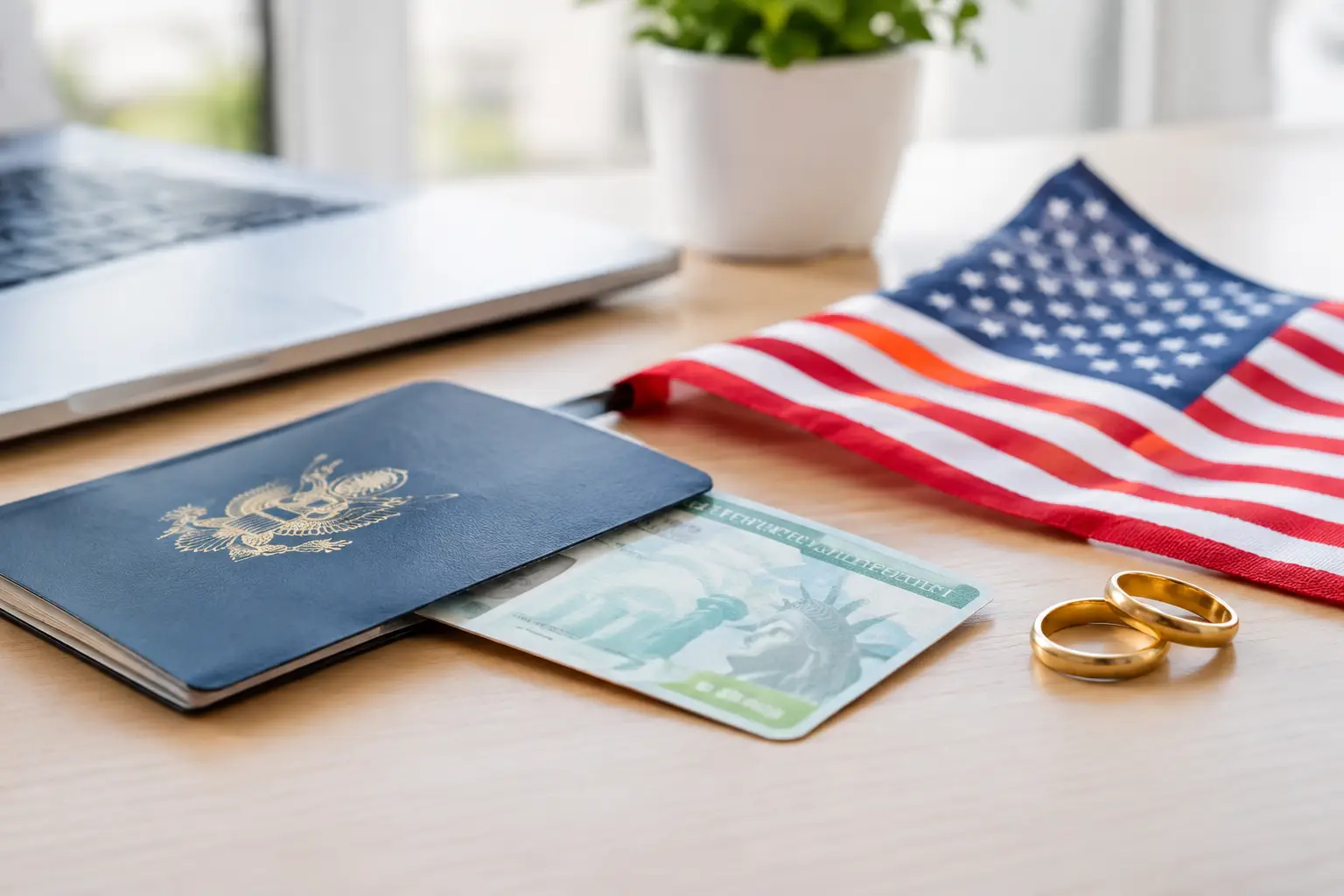
A wedding in the United States is not, by itself, an immigration problem. The risk begins when a visit under the Visa Waiver Programme is used as a planned route to permanent residence. Can You Travel to the US on an ESTA, Marry a US Citizen or Green Card Holder, and Apply for a Green Card inside the US? Sometimes, yes. But the answer turns on your immigration intent when you sought admission, who you marry, your immigration history, and the evidence available to explain the sequence of events.
ESTA approval is not a visa and does not guarantee admission at the border. It permits an eligible traveller to request entry to the United States for up to 90 days under the Visa Waiver Programme. A Customs and Border Protection officer decides whether to admit you, and may question the purpose of the trip, your ties outside the US, your return arrangements, and any indication that you intend to stay permanently.
ESTA, marriage and applying for a green card in the US
A person admitted on ESTA may legally marry in the United States. US immigration law does not prohibit a visitor from getting married during a trip. Equally, marrying a US citizen does not automatically prove immigration fraud, and it does not automatically give the foreign national a green card.
The decisive question is whether you genuinely intended a temporary visit when you arrived. If you entered knowing that you would marry, remain in the US, and file for a green card, an officer may conclude that you misrepresented your purpose of travel. A finding of fraud or wilful misrepresentation can create a permanent inadmissibility issue. That is a far more serious consequence than a delayed application.
Life does change after entry. A couple may decide to marry after an unexpected proposal, a family event, a changed job situation, illness, or a genuine decision to build a life together. A legitimate change of circumstances can support an in-country application. However, it must be credible, consistent with the facts, and capable of being explained with care. A convenient story created after the event is not a legal strategy.
ESTA is not a shortcut around the immigrant visa process
The distinction is practical as well as legal. If the plan is already to marry and settle in the United States, entering on ESTA is usually the wrong starting point. The appropriate route may be an immigrant visa through consular processing, or, for an unmarried couple where the US partner is a citizen, a fiancé visa may be considered.
Trying to save time by entering as a visitor with a settled plan to immigrate can instead produce border refusal, application scrutiny, a removal process, or a long-term inadmissibility problem. The fact that someone is allowed through the airport does not confirm that their immigration plan was lawful.
The answer changes depending on your spouse’s status
Whether your spouse is a US citizen or a green card holder is not a minor detail. It can determine whether adjustment of status inside the US is available at all.
If you marry a US citizen
The spouse of a US citizen is an “immediate relative” under US immigration law. There is no annual visa quota for immediate relatives. A foreign national who was lawfully admitted on ESTA may, in many cases, file a family petition and an adjustment of status application from within the US after a bona fide marriage to a US citizen.
Certain technical breaches that would block other applicants, including overstaying a permitted period or working without authorisation, can be forgiven for immediate relatives of US citizens when applying for adjustment. That does not forgive fraud, criminal issues, prior removals, unlawful-presence complications, false claims to US citizenship, or other grounds of inadmissibility.
Visa Waiver Programme entrants also have restricted rights to challenge removal. This makes a weak ESTA-based strategy particularly hazardous. If USCIS denies the adjustment application or immigration authorities take enforcement action, the options available may be more limited than many applicants expect.
If you marry a green card holder
The analysis is substantially different where the spouse is a lawful permanent resident rather than a US citizen. The foreign spouse falls within a family-preference category, usually known as F2A, and must have an immigrant visa number available before adjustment can be approved.
More importantly, the Visa Waiver Programme adjustment exception is generally limited to immediate relatives of US citizens. A spouse of a green card holder will usually not be able to adjust status from ESTA inside the United States. Remaining beyond the 90-day ESTA period can make the position worse, not better.
In many such cases, the safer route is consular processing from outside the US after the family petition is approved and a visa number is available. If the green card holder later naturalises as a US citizen, the category and options may change, but timing, status history and any period of unlawful presence still require careful analysis.
Intent at entry: the issue that decides the risk
Immigration officers do not rely on one fact alone. They assess the full picture. A return ticket, continuing employment in the UK, a rented home, children at school, a short visit itinerary, and a previously established relationship can all be relevant, though none is conclusive.
Conversely, bringing all personal possessions, resigning from work before departure, shipping household goods, telling friends you are emigrating, or arriving with completed green card paperwork may undermine the claim that the visit was temporary. Messages between the couple can also become relevant if the government questions intent.
Some applicants refer to a so-called 90-day rule. This is often misunderstood. Timing can attract scrutiny, particularly where a person marries and files quickly after arrival, but there is no safe number of days after which a pre-existing plan becomes lawful. Waiting 91 days does not cure an intention to immigrate that existed before entry. Equally, filing within 90 days is not automatic proof of fraud where circumstances genuinely changed.
The correct question is not, “How long should we wait?” It is, “What was the genuine purpose of travel at the point of entry, and can the evidence support that account?”
What a properly prepared marriage case must show
A marriage-based application requires more than a marriage certificate. USCIS will expect evidence that the marriage was entered into in good faith, not solely to obtain an immigration benefit. Couples commonly use evidence of living arrangements, shared finances, communication, photographs over time, travel, family involvement and credible statements explaining the development of the relationship.
The evidence must also align with the immigration record. Dates on travel history, ESTA applications, prior visa forms, social media, address records and the couple’s account should not conflict. Small inconsistencies may be understandable; material contradictions can damage credibility across the entire case.
The foreign national must also be admissible to the US. Previous visa refusals, arrests, overstays, removals, immigration applications, medical issues and prior use of another person’s identity can alter the legal route. A waiver may be possible in some circumstances, but it should be identified before a filing is made, not after a refusal.
Do not work or travel on assumptions while the case is pending
Filing an adjustment application does not immediately grant permission to work. ESTA itself does not permit employment in the United States. Work should not begin unless and until the applicant has separate work authorisation or another valid basis to work.
International travel also requires caution. Leaving the US while an adjustment application is pending can have serious consequences, including possible abandonment of the application or difficulty returning. Travel permission is not a detail to resolve at the airport. It should be assessed against the applicant’s exact status and history before any booking is made.
A decision framework before you travel
Before relying on ESTA, establish whether marriage and permanent residence are already part of the plan. If they are, seek advice on the correct immigrant or fiancé route before travelling. If marriage arose after a genuine temporary entry, assess whether the spouse is a US citizen, whether the ESTA admission was lawful, whether any inadmissibility issues exist, and whether the available evidence supports both the relationship and the change in circumstances.
This is not an area for copied timelines or reassurance from online forums. The consequences of getting entry intent wrong can extend far beyond one application. A focused legal assessment before travel, filing, working or leaving the US can protect both the relationship and the immigration future you are trying to build.
Leave a Reply